
Beyond the Naked Eye
For decades, inspectors relied on ladders, flashlights, and sheer experience. Today, a drone hovers 200 feet in the air capturing 10,000 data points per second — and a thermal camera reads heat signatures invisible to any human eye. The inspection industry is undergoing one of its most dramatic transformations in history.
What once took days of dangerous manual labor can now be accomplished in hours — with greater accuracy, richer documentation, and safer conditions for everyone involved. This is not science fiction. It’s happening right now on rooftops, power lines, pipelines, and construction sites across the country.
85%
Reduction in
inspection time
60%
Lower cost vs.
traditional methods
3X
More surface area
covered per day
Three Technologies Reshaping the Industry
01 — Drones: Seeing the Unseeable
Before drones, inspecting a large commercial roof meant assembling scaffolding, navigating slippery surfaces, and hoping conditions stayed dry. Inspectors could only see what they could physically stand next to. Today, a trained drone pilot can survey the same roof in under an hour — producing a photographic record no clipboard could match.
“ A drone can capture every inch of a 50,000 sq ft roof at 1cm/pixel resolution — mapping every crack, blister, and failed seam — in a single 45-minute flight. ”
Roofing & Building Envelopes — High-resolution imagery from above reveals membrane failures, ponding water patterns, and flashing separations invisible or dangerous to approach from ground level.
Energy Infrastructure — Power utilities now use drones to inspect hundreds of miles of transmission lines in a single day, automatically flagging damaged insulators and vegetation encroachments.
Bridges & Civil Structures — Multirotor drones inspect the underside of bridges, piers, and girders — eliminating the need for expensive snooper trucks and lane closures.
Solar Farms — A single drone pass with a thermal camera identifies underperforming panels across a 10-acre installation in less time than a technician could walk one row.
02 — Thermal Imaging: Reading Heat as Data
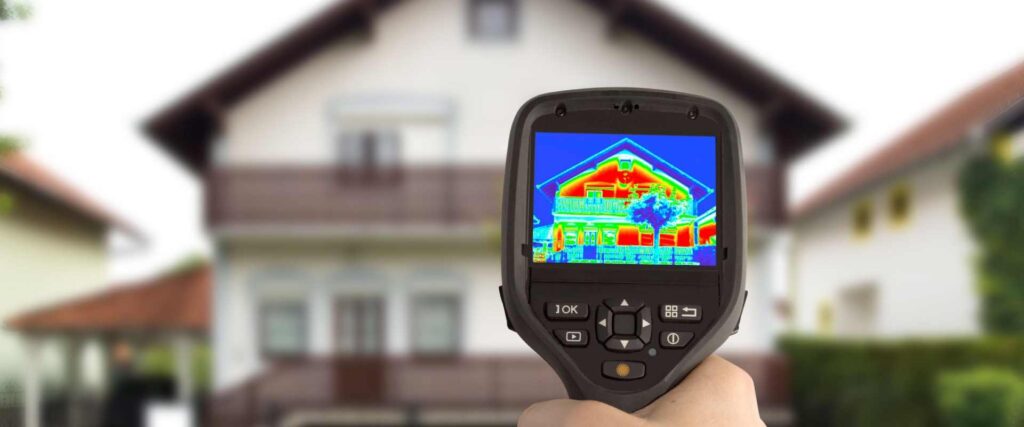
Every material tells a thermal story. Water-saturated insulation retains heat differently than dry material. An overloaded electrical breaker glows bright in infrared before it becomes a fire hazard. A missing vapor barrier creates telltale cold spots visible only to a thermal camera.
“ Thermal cameras don’t lie. They show you what’s actually happening inside a wall, under a roof membrane, or behind an electrical panel — no destructive testing required. ”
Traditional vs. Thermal + Drone
|
Inspection Task |
Traditional Method |
Thermal + Drone |
|
Roof moisture detection |
Core cuts, probing |
Full scan in 1 flight |
|
Electrical fault finding |
Manual load testing |
Instant thermal map |
|
Building energy loss |
Blower door + guesswork |
Visualized in real time |
|
Solar panel faults |
Panel-by-panel testing |
Entire farm in one pass |
|
High-rise facade cracks |
Rope access inspection |
Safe aerial imaging |
03 — When Technologies Converge
The real power emerges when drone flight, thermal imaging, and AI analysis work together as a unified system. A drone captures thermal and visual data simultaneously. Software stitches thousands of frames into a georeferenced map. AI flags every anomaly and populates a structured report — all before the inspector has packed up the equipment.
“ Technology doesn’t replace the inspector’s eye — it gives that eye superpowers. ”
Digital Documentation — Every finding is geotagged, timestamped, and linked to a precise location on the building model. Reports that once took days are generated automatically, with annotated images and thermal overlays.
Predictive Maintenance — Repeated scans over time create a baseline. AI detects subtle changes before they become expensive failures, shifting inspections from reactive to predictive.
Risk Reduction — Falls remain the leading cause of construction fatalities. Technologies that keep inspectors off unstable roofs and away from energized equipment are not just efficient — they’re lifesaving.
The Future Is Already Here
Inspectors who embrace these technologies aren’t just working faster — they’re working smarter, safer, and delivering insights their clients have never had access to before.